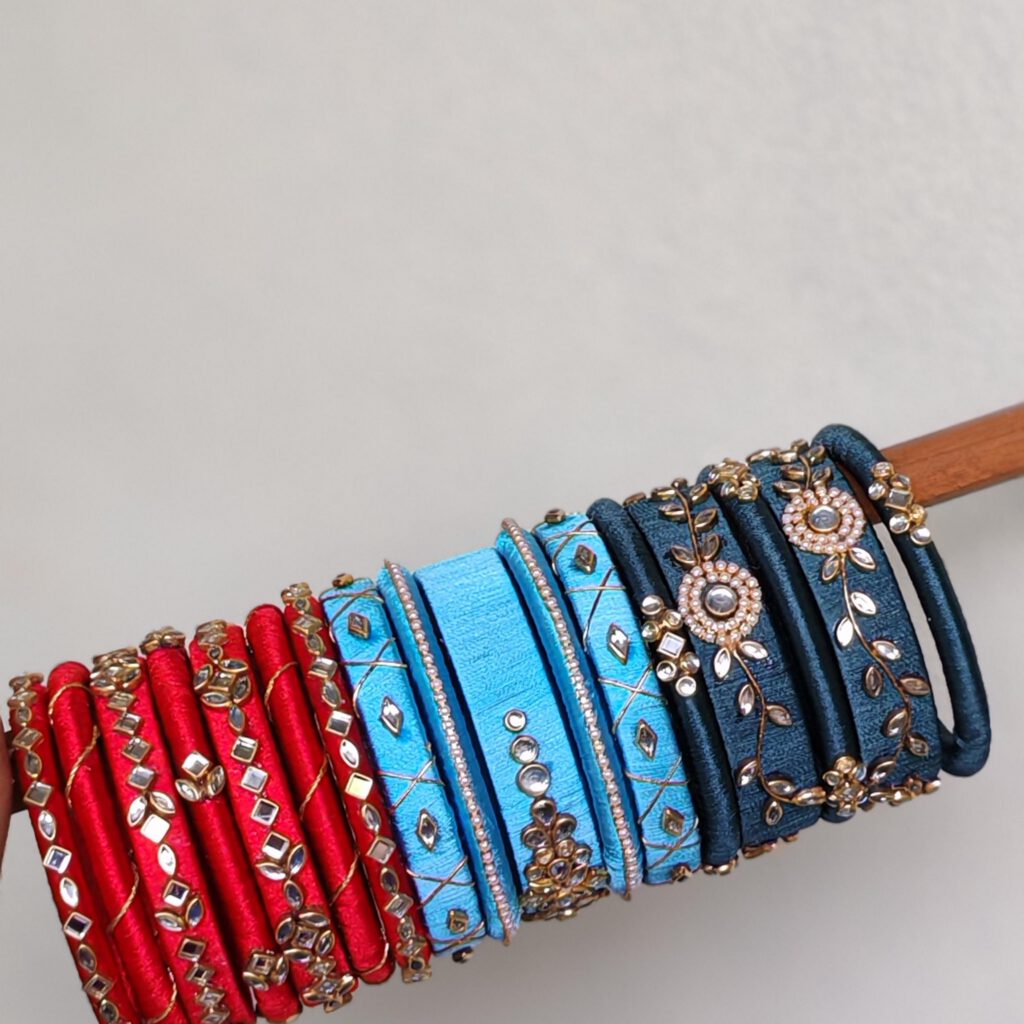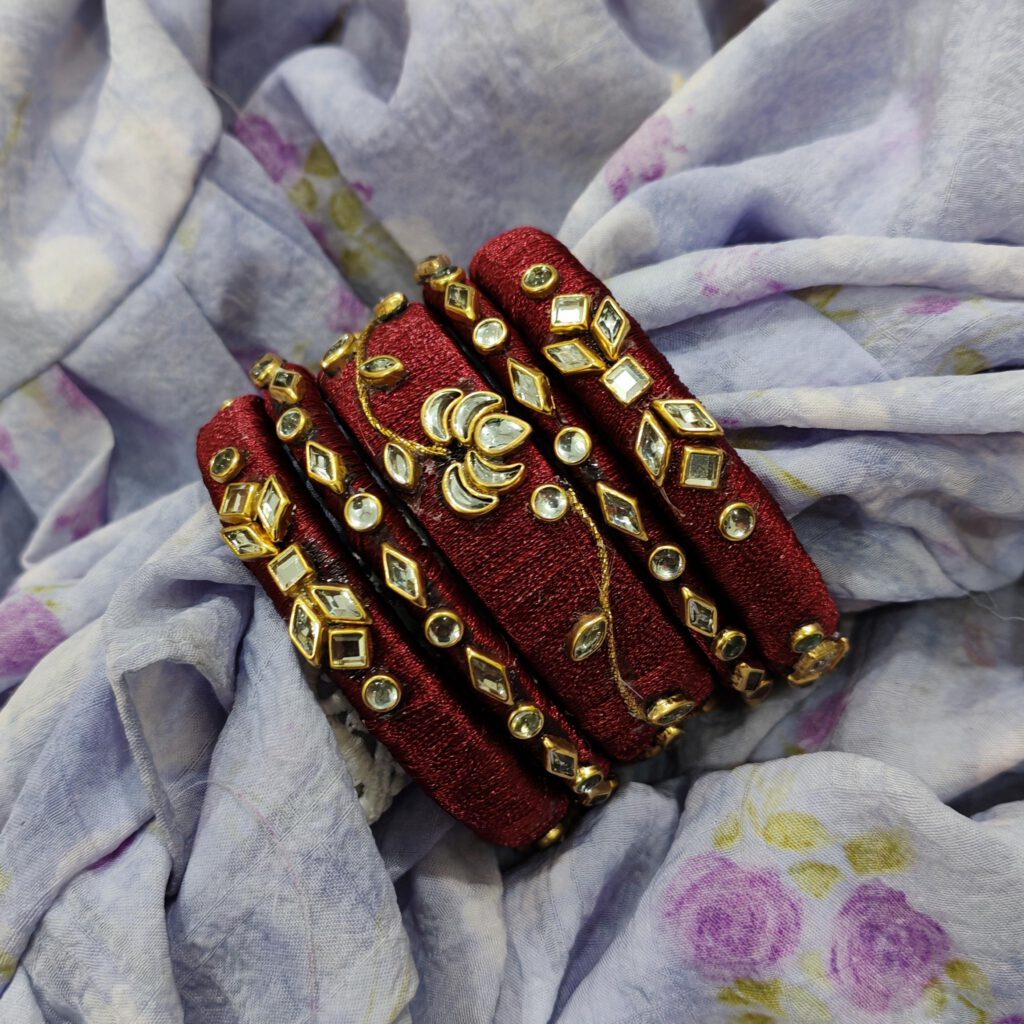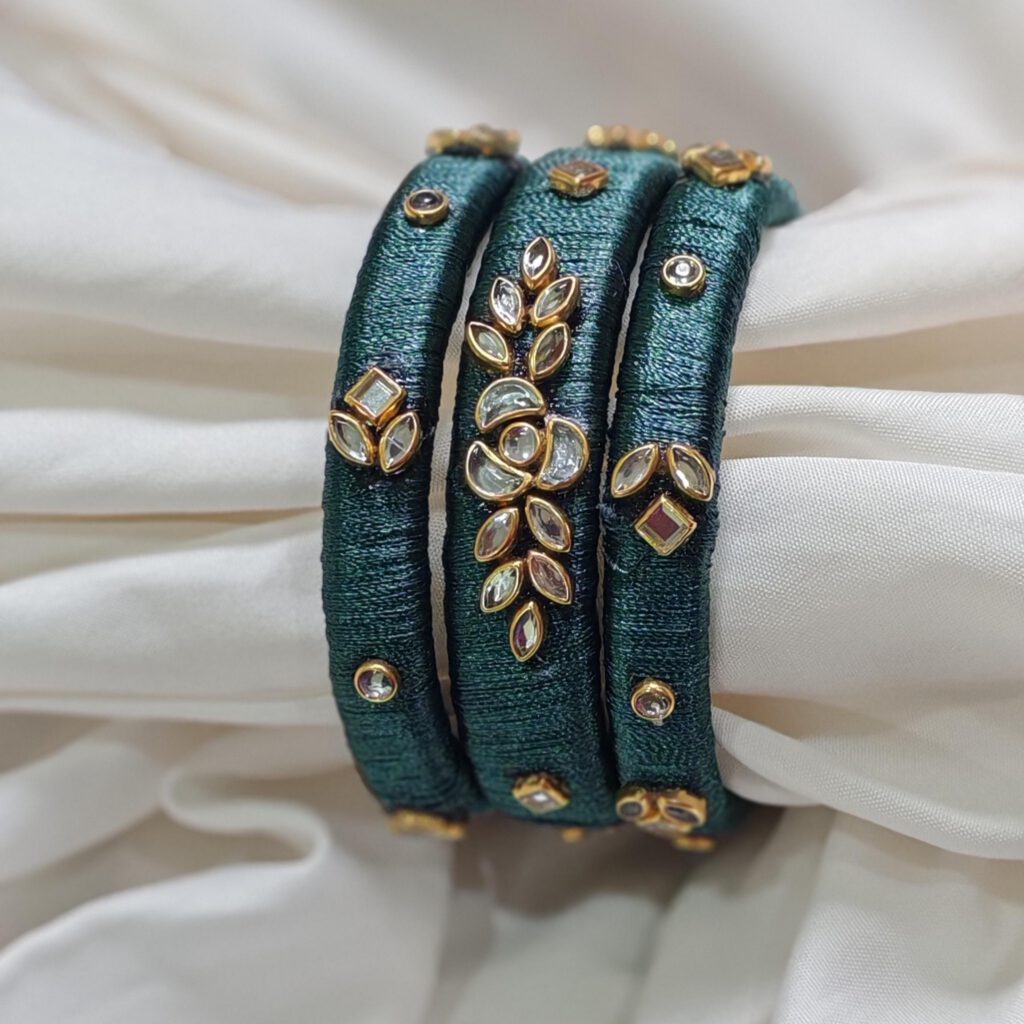
Nearly every piece we make carries kundan stones, and nearly every customer asks the same question: what is kundan jewelry, and is it real? This post gives a straight answer – what the stones are, how the traditional and modern methods differ, how we set them on silk thread bangles and kundan rings, and how to tell good kundan work from bad.
What is kundan jewelry? The short answer
Kundan is a setting style, not a gemstone. In traditional kundan work, a glass or gemstone is held in place by highly refined gold foil (kundan means pure gold in Hindi and Urdu) pressed around it, with no prongs or claws. The style developed in Rajasthan and Gujarat and became the court jewelry of the Mughal period. Today the word is used for any flat-backed glass stone with a gold-coloured foil back and frame, which is what is used on handmade fashion jewelry across South Asia, including ours.
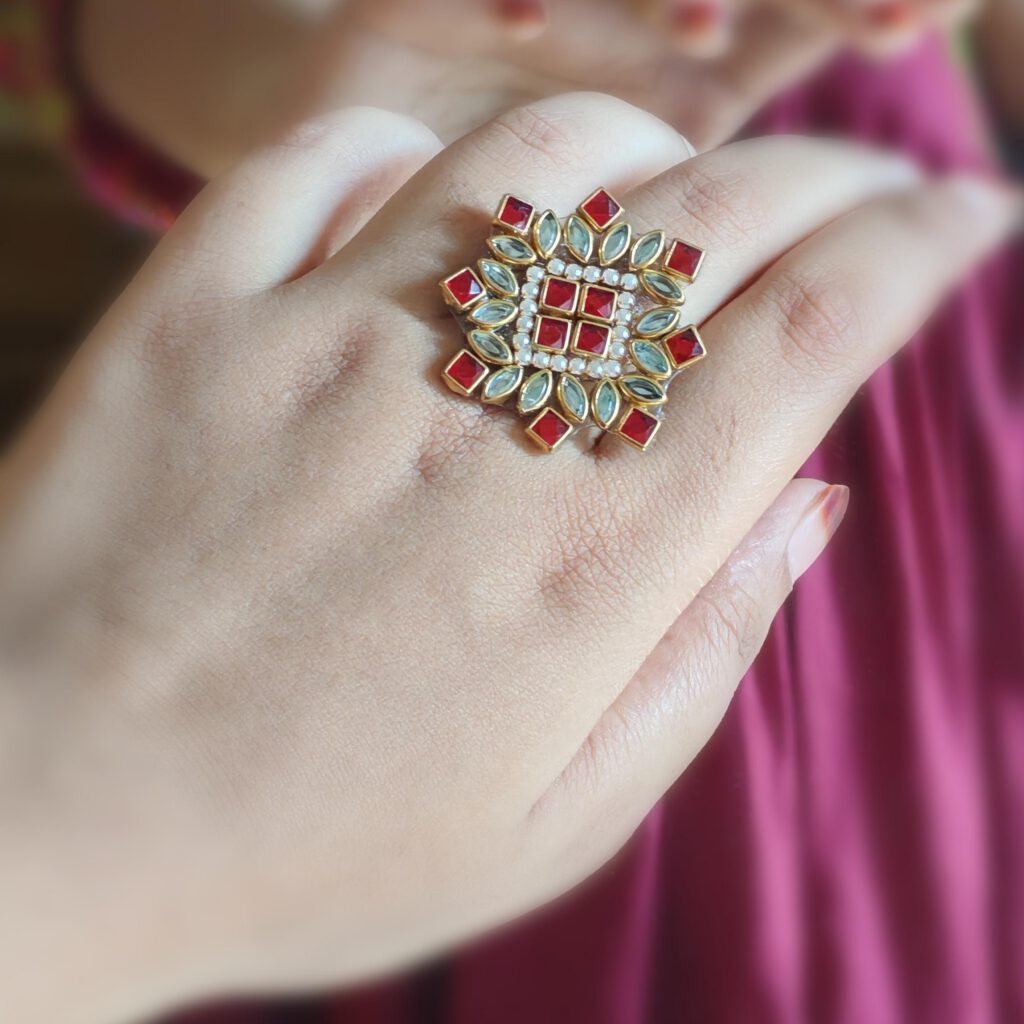
How modern kundan stones are made
The stones used on thread bangles and fashion rings are cut glass with a flat back. The back is coated with a reflective foil – silver or gold coloured – which is what makes the stone bright even though glass itself is not very reflective. A thin gold-tone metal frame is then bonded around the edge. The frame is the part that looks like the old gold-foil setting. Stones come in standard shapes: round, oval, marquise (leaf), square, teardrop and the pointed navette used for flower petals.
Kundan vs polki vs AD
- Kundan: glass stone, foil back, gold-tone frame. Flat, soft glow. Used on our bangles, rings, earrings and necklaces.
- Polki: uncut or rough-cut natural diamond in a gold setting. Real polki is expensive fine jewelry; “polki” on fashion jewelry usually means a kundan-style stone with an irregular, uncut look.
- AD (American Diamond): cubic zirconia, faceted and sparkly like a diamond, usually prong-set in a rhodium or gold-plated base. Sharper sparkle than kundan.
Kundan on silk thread suits the material: a soft glow against matte thread. AD stones look out of place on thread and their prong settings snag it, which is why we do not use them on bangles.
How we set kundan on thread
Each stone is glued with fabric adhesive to the wrapped thread. Patterns – a line of squares, a flower of eight petals around a round centre, a leaf of marquise stones – are laid out on the first bangle and copied across the set. On rings, stones are set into a metal base and the ring is finished in gold tone. Full details are in how silk thread bangles are made.
How to judge quality
- Frame fit: the gold frame should sit flush around the glass with no gap. A loose frame is the first thing to fall off.
- Foil: look at the stone from the side – the foil should be complete with no dark patches. Patches mean moisture has already reached it.
- Symmetry: on a flower motif, petals should be evenly spaced. Uneven spacing means the maker rushed.
- Glue: no visible glue around the stone edges on thread work.
Care
Kundan stones must stay dry. Wet foil tarnishes and the stone goes dark. Wipe with a dry cloth only, and follow the rest of the care guide.
You can see kundan work on every set in the Bangles and Rings collections, and read about custom stone colours on the handmade rings page. For the history of the traditional gold-foil technique, see Kundan on Wikipedia.