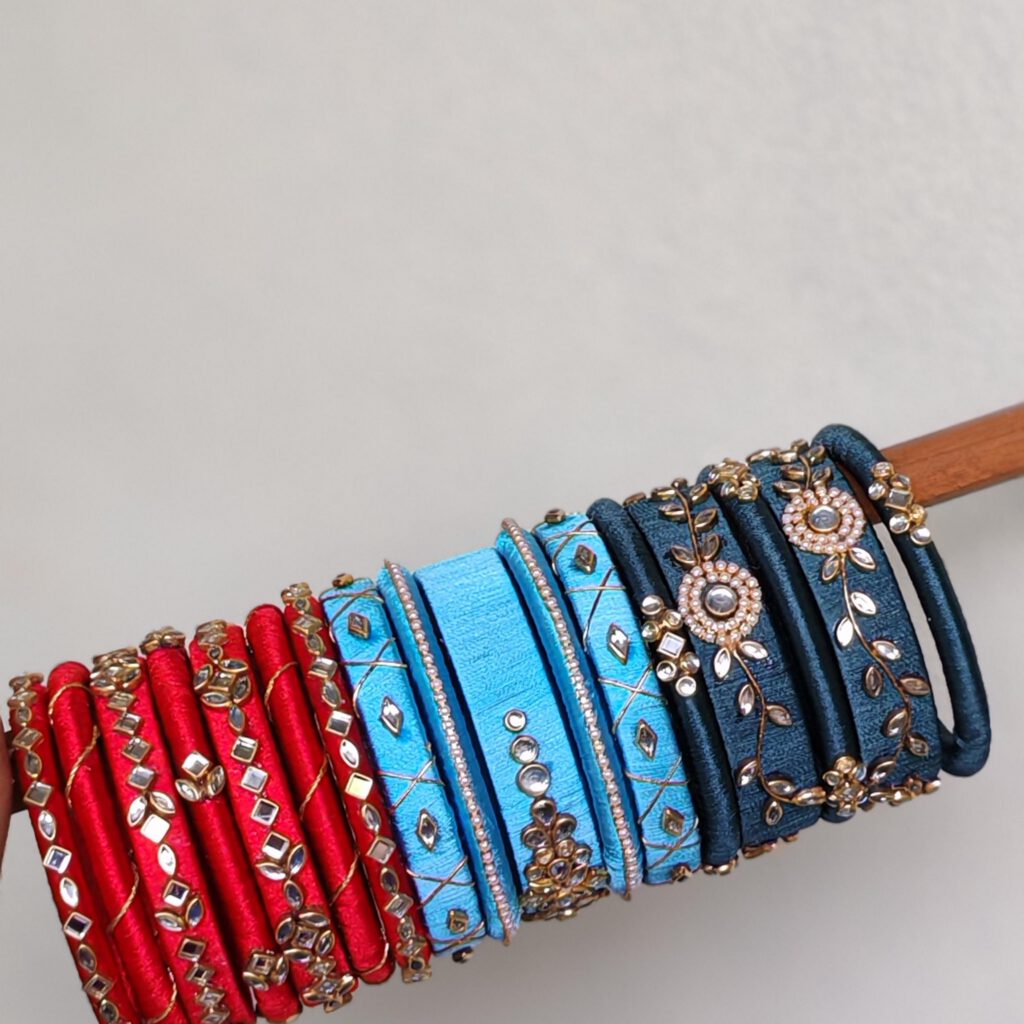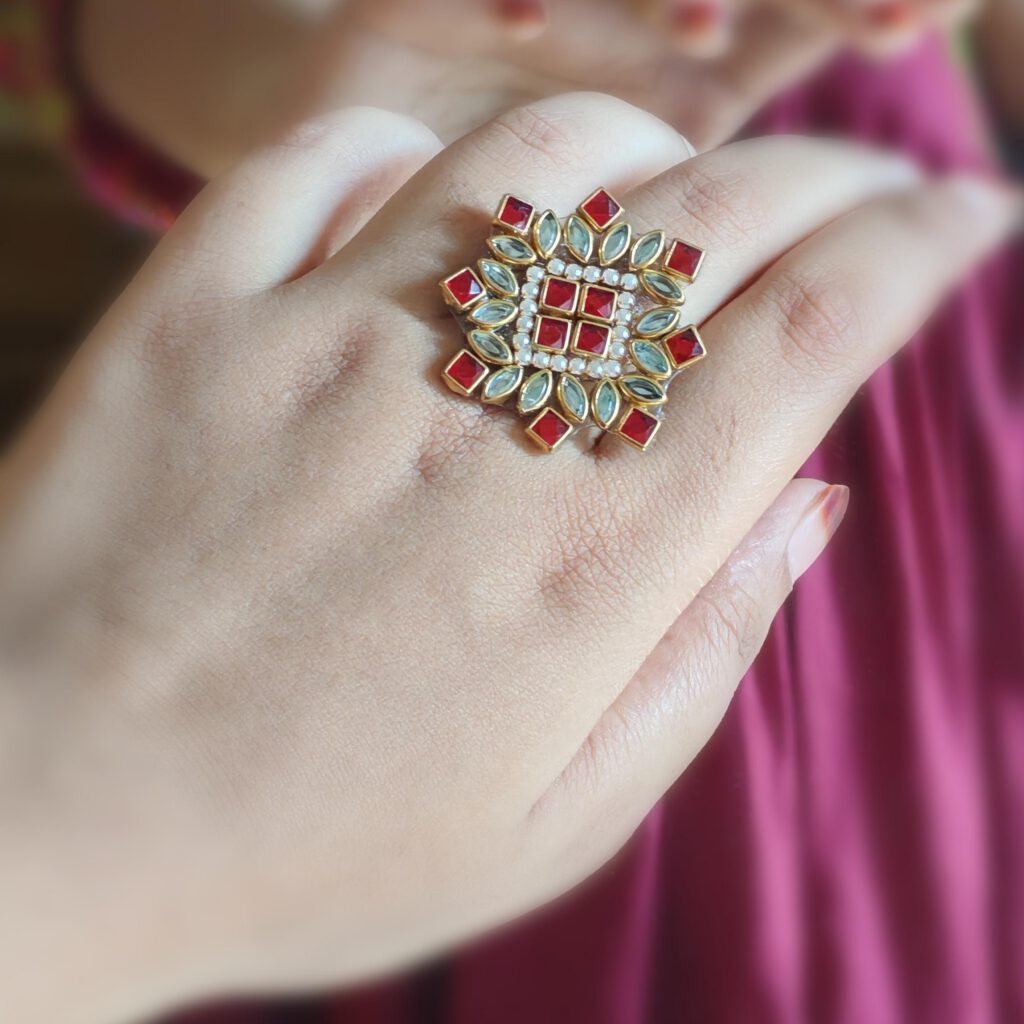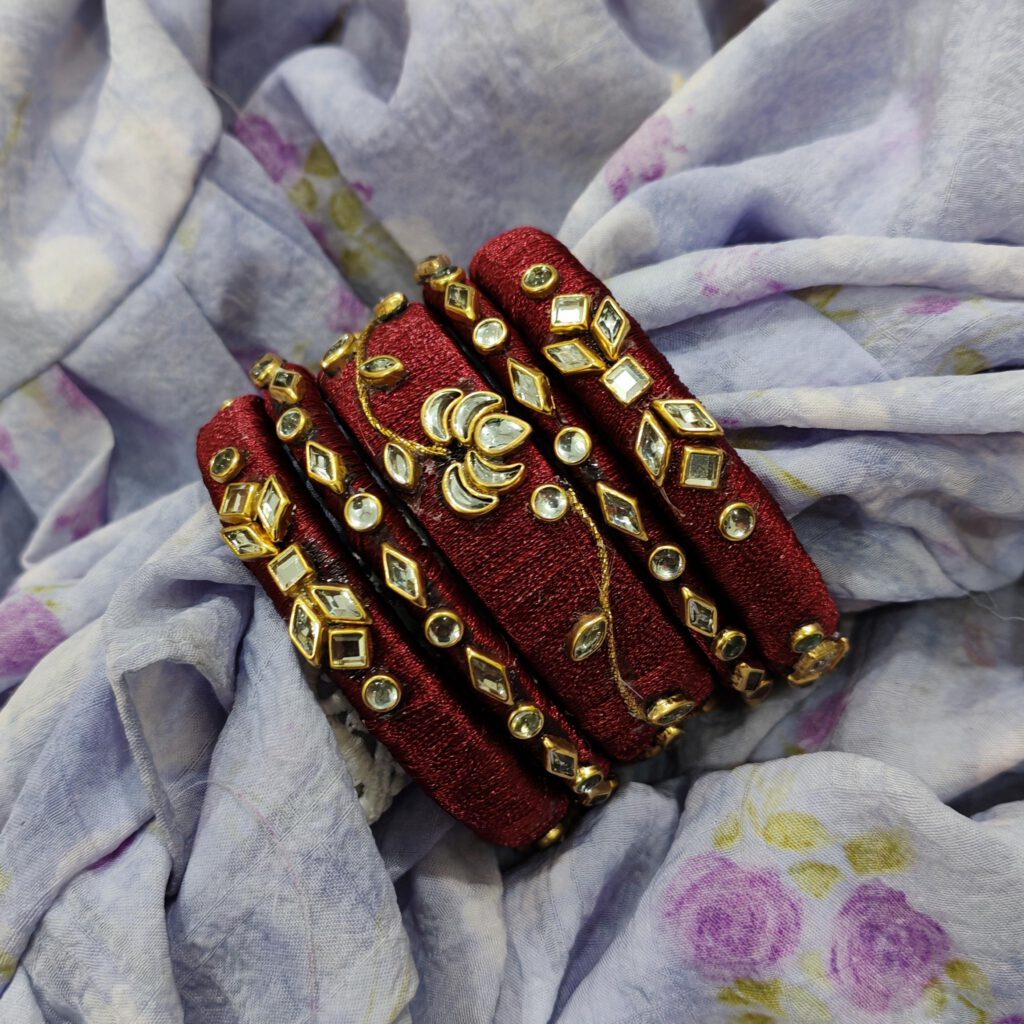
People often ask why a set of silk thread bangles costs more than glass bangles from the market. The answer is time. This post explains how silk thread bangles are made in our workshop in Feni, in the order we actually do it. Nothing here is automated; the steps below are done by one person with thread, glue and tweezers.
1. The base ring
Every silk thread bangle starts with a plain base. We use two kinds: a rigid plastic ring for standard bangles, and a flat brass ring for the wider centre kada in a bridal set. Bases come in the sizes used in Bangladesh – 2.2, 2.4, 2.6, 2.8 and 2.10 inches inner diameter – and the size is fixed at this stage. Once wrapped, a bangle cannot be made larger or smaller, which is why we ask for the wrist measurement before starting. Our bangle size guide explains how to measure.
2. Choosing and cutting the thread
Silk thread for bangles is sold in skeins by shade number. For a set that must match, all bangles in the set are wrapped from the same skein because two skeins of the same shade number can differ slightly. A 2.6 bangle takes roughly six to eight metres of thread depending on how thick the base is.
3. Wrapping
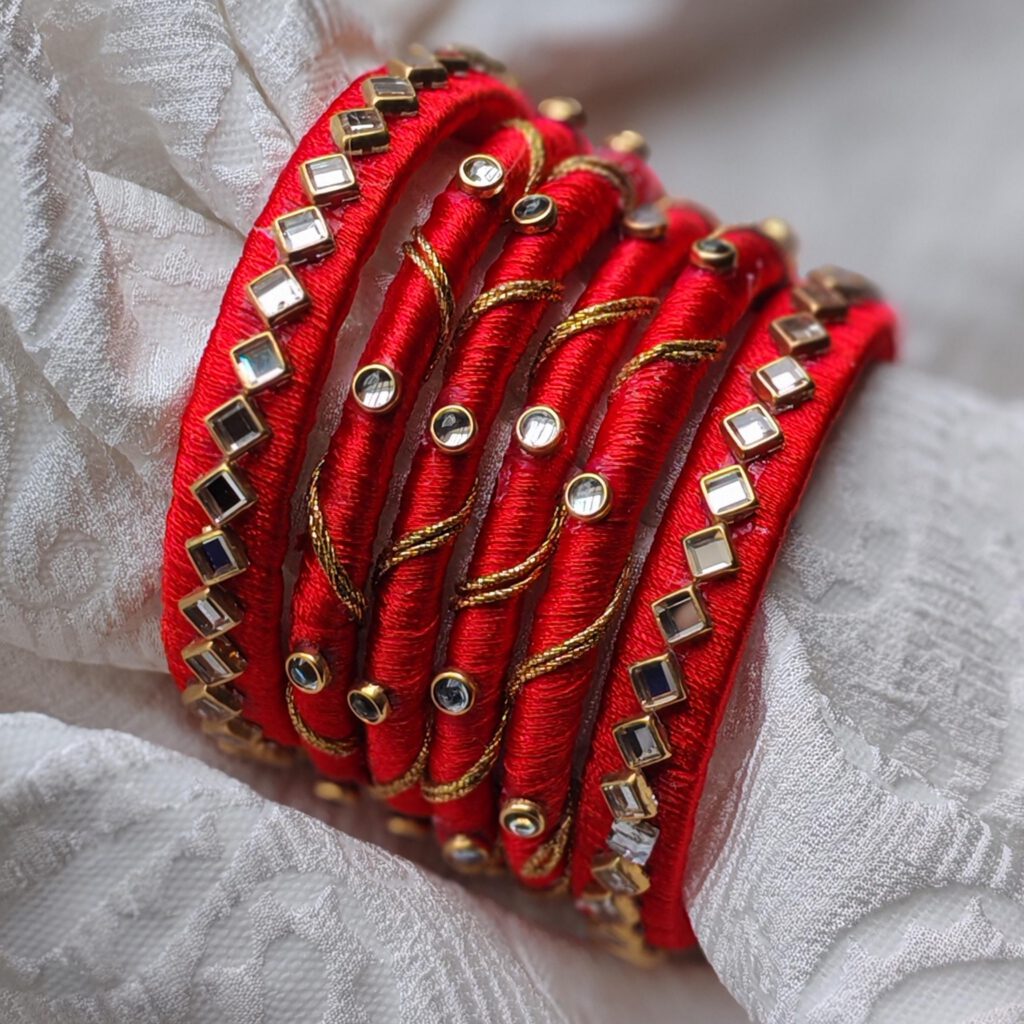
The thread end is glued to the inside of the base and the wrapping begins. Each turn is laid tight against the previous one so no base shows through. The maker keeps constant tension; loose turns create gaps, tight turns twist the thread and dull the shine. A plain 2.6 bangle takes about 25–35 minutes to wrap. The end is glued on the inside and trimmed flush.
4. Wire and thread patterns
For gold-wire styles, a fine gold-tone wire is wound over the finished thread in a criss-cross or spiral before the stones go on. For two-tone bangles, a second thread colour is wrapped in bands over the first. These steps add another 15–20 minutes per bangle.
5. Setting kundan stones
Kundan stones are flat-backed glass in a gold-tone foil frame. Each stone is picked up with tweezers, a dot of fabric glue is applied, and the stone is pressed onto the thread. Patterns – a straight line, a flower, a leaf, a diamond – are laid out on the first bangle and then copied on the rest of the set so they line up when stacked. Setting stones is the slowest step; a bangle with a full flower motif can take 40 minutes on its own. See what kundan is for more on the stones.
6. Drying and checking
Finished bangles rest for at least twelve hours so the glue cures fully. Then each one is checked: stones pressed, thread ends tested, inner surface smooth. Any bangle that fails is re-wrapped. Sets are stacked to confirm the pattern lines up and photographed for the customer.
7. Packing
Sets are fixed to a card and packed in a rigid box so the stones do not rub in transit. Bangles going to Dhaka or Chittagong arrive in a day or two; those going to Rangpur or Khulna travel for up to five days, so the packing matters.
How silk thread bangles are made: time per set
A plain set of eight bangles takes four to five hours. A bridal set with a wide kada and stone motifs takes eight to twelve hours across two days including drying. That is the reason for the price difference against machine-made bangles, and the reason each set is slightly different from the last.
If you want a set made to your own colour and size, see custom silk thread bangles or browse the ready-made Bangles collection. The wider history of the bangle in South Asia goes back thousands of years; silk thread is a recent chapter in it.